
Performance Marketing
Break Even ROAS: How D2C Founders Should Set Meta Ads Targets
Stop copying 3X ROAS benchmarks. Learn how to calculate break even ROAS from your own margins and turn it into Meta ads targets your team can act on.
· 8 min read

Most D2C founders set their Meta ads target the same way: someone in a WhatsApp group said "3X ROAS is good", so 3X becomes the goal. The problem is that 3X can be a healthy number for one brand and a slow bleed for another. Your break even ROAS is the only number that tells you whether an ad is making money, and it comes from your own margins, not from a benchmark.
This guide shows how to calculate break even ROAS for an Indian D2C brand, how to adjust it for COD, RTO and repeat purchases, and how to turn it into targets your team or agency can run campaigns against.
What ROAS actually measures
ROAS (return on ad spend) is revenue divided by ad spend. If you spend ₹10,000 and Meta reports ₹40,000 in purchase value, your ROAS is 4.
ROAS says nothing about profit on its own. It ignores product cost, shipping, gateway fees, returns and GST. A ₹40,000 revenue day on a 30% margin product is very different from the same day on a 70% margin product. That is why the target has to start from margin.
Two related terms you will see:
- CPA (cost per acquisition): ad spend divided by purchases. Useful when every order has a similar value.
- MER or blended ROAS: total revenue from all channels divided by total marketing spend. This is the number that shows up in your bank account.
How to calculate break even ROAS
The formula is simple:
Break even ROAS = 1 ÷ contribution margin %
Contribution margin is what is left from one order after all variable costs, before ad spend. To get it right, build it from the net selling price, not the MRP.
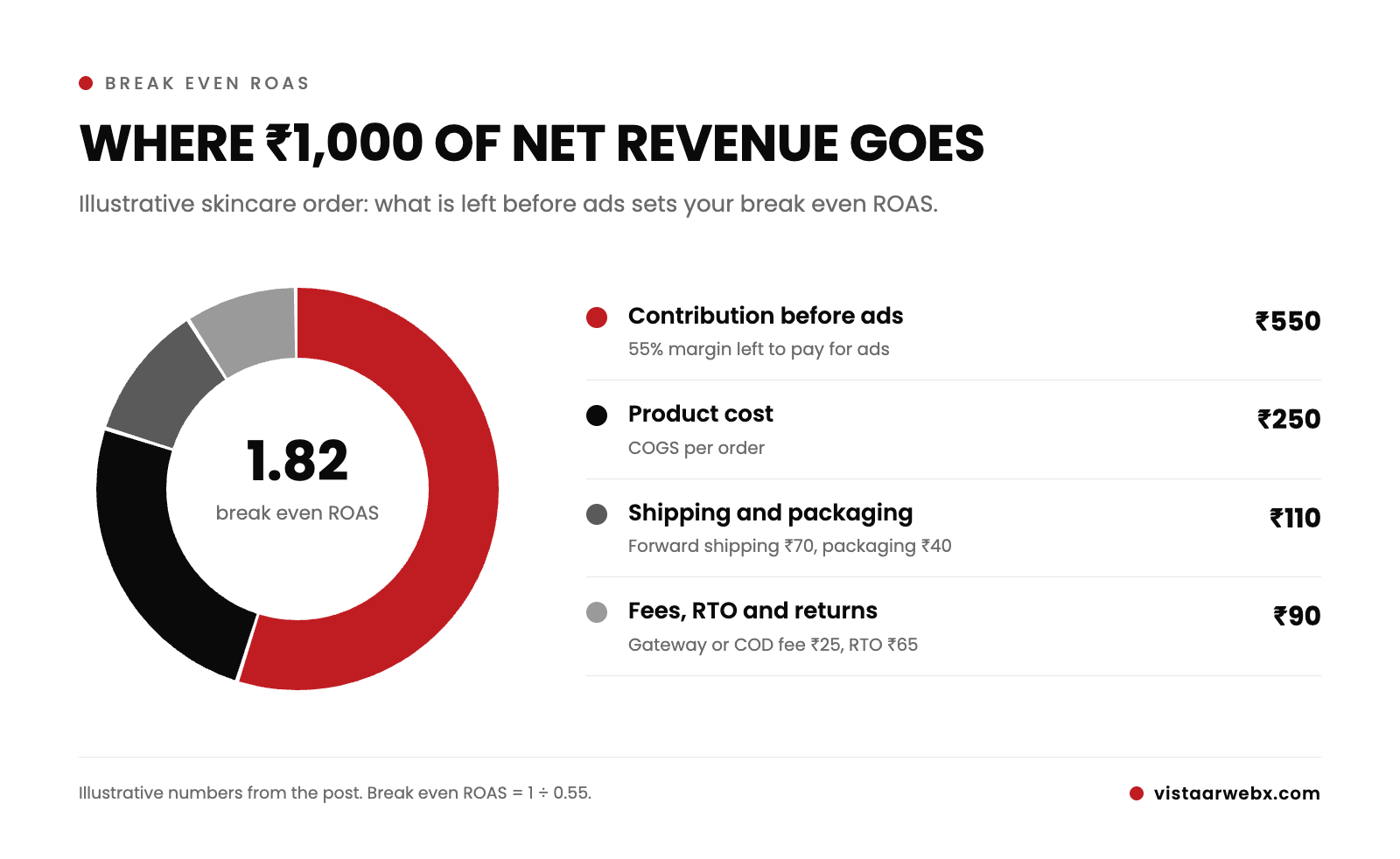
Here is an example for a skincare product. All numbers are illustrative.
| Line item | Per order (₹) |
|---|---|
| Selling price (incl. GST) | 1,180 |
| Less GST at 18% | 180 |
| Net revenue | 1,000 |
| Product cost (COGS) | 250 |
| Packaging | 40 |
| Shipping (forward) | 70 |
| Payment gateway or COD fee | 25 |
| Expected cost of RTO and returns | 65 |
| Contribution before ads | 550 |
Contribution margin is ₹550 ÷ ₹1,000 = 55%. Break even ROAS is 1 ÷ 0.55 = 1.82 on net revenue.
There is a catch. Indian stores usually show tax-inclusive prices, so the purchase value your store sends to Meta often includes GST. Check what your setup sends. If it includes GST and you compare against Meta's number, use the GST-inclusive price: ₹550 ÷ ₹1,180 = 46.6%, which gives a break even ROAS of about 2.15 on reported revenue.
This one detail trips up a lot of founders. Decide whether you are working on gross or net revenue and keep every target in the same unit.
The costs most founders forget
A break even number is only as good as the costs inside it. These are the lines that usually go missing:
- RTO on COD orders. When a COD order is refused, you pay forward shipping, return shipping and often lose the packaging. Spread that cost across all orders, using your actual RTO rate by pin code or category if you have it.
- Customer returns and exchanges. Fashion and footwear brands carry this heavily. Add the reverse logistics cost and any stock that cannot be resold.
- Discounts. If 40% of orders use a 10% coupon, your average selling price is lower than the listed price.
- Payment fees. Gateways typically charge a percentage per prepaid transaction, and COD remittance has its own fees. Check your current rates.
- Free gifts and samples. If every order gets a ₹30 sample, it is a cost of the order.
- App and fulfilment fees that scale with orders. Per-order charges from your warehouse, WhatsApp confirmation tools or review apps.
Fixed costs like salaries, rent and the Shopify plan do not go into contribution margin. They are paid from the profit you make after ads.
From break even ROAS to a target ROAS
Break even is the line where an order neither makes nor loses money. You do not want to run there. To get a target, decide how much contribution you want to keep per order after ads.
Target ROAS = 1 ÷ (contribution margin % minus desired profit %)
Using the example above on net revenue: contribution margin is 55%. If you want to keep 15% of net revenue as profit after ads, the ad cost can be 40% of revenue. Target ROAS = 1 ÷ 0.40 = 2.5.
A simple way to present this to your team:
| Zone | ROAS on net revenue | What it means | Action |
|---|---|---|---|
| Losing money | Below 1.82 | Each order loses money | Cut or fix within days |
| Break even to target | 1.82 to 2.5 | Profitable but thin | Hold budget, refresh creative |
| Above target | Above 2.5 | Healthy profit per order | Scale budget gradually |
Write these numbers into your weekly report so every budget decision is tied to them.
Adjusting for repeat purchases
A strict first-order break even ROAS can make you too conservative. If customers come back, the first order is only part of the value you buy with ad spend.
For example, if a coffee or skincare customer typically places two more orders within six months, and those repeat orders come through email, WhatsApp or organic search at very low cost, you can afford a lower ROAS on the first order. Some brands deliberately run first orders close to break even and make their profit on the second and third orders.
To do this safely:
- Measure repeat rate from your own Shopify data, by cohort month, not from a guess.
- Use a short payback window, such as 90 or 180 days, especially if cash is tight.
- Keep a separate "first-order ROAS floor" so you never fall into losing money on day one while waiting for repeat orders that may not come.
Brands selling one-time products, like furniture or a single gift item, should stick closer to first-order break even.
COD, RTO and the ROAS Meta reports
Meta counts a purchase when the order is placed. It does not know whether the COD parcel was refused at the door. If your RTO rate on COD is high, the ROAS in Ads Manager overstates real revenue.
Two ways to correct for this:
- Adjust the target. If roughly 20% of COD revenue never gets delivered (example figure), raise your target ROAS on COD-heavy campaigns to compensate.
- Adjust the data. Track delivered revenue in Shopify or your logistics dashboard and compare it with Meta-reported revenue every week. The gap is your real attribution and RTO error.
Prepaid nudges such as a small prepaid discount or partial COD advance reduce RTO and make reported ROAS closer to reality. Factor the discount into your margin when you do this.
Using break even ROAS in campaign decisions
Once the numbers are set, they should drive daily and weekly decisions. A practical rule set:
- Judge ad sets on a three to seven day window, not a single day. Meta's results swing day to day.
- If an ad set is below break even for five or more days with meaningful spend, cut it or change the creative.
- If it is between break even and target, hold budget and test new creative or a better landing page.
- If it is above target for a week, raise budget by about 15 to 20% and check again in two to three days.
- For Advantage+ or Highest Volume campaigns, you can set a minimum ROAS goal close to your target, but leave room for the system to learn. Setting it too tight often stops delivery.
Read Meta's help documentation on ROAS goals and bid strategies before you switch, because the options and their names change from time to time.
Blended ROAS is the reality check
Platform ROAS is useful for comparing ads against each other. Blended ROAS, or MER, tells you whether the business is working.
Calculate it every week: total Shopify revenue (delivered, net of returns if possible) divided by total ad spend across Meta, Google and any other paid channels. Then compare it with a blended break even that accounts for your repeat revenue.
If Meta says 3X but blended ROAS is 1.6X, either attribution is overcounting, RTO is high, or other channels are being credited to Meta. That gap is where most profit leaks hide.
A quick checklist
- Calculate contribution margin from net selling price after GST and discounts
- Include RTO, returns, gateway fees, packaging and per-order app fees
- Decide whether targets are on gross (GST-inclusive) or net revenue
- Set break even ROAS, target ROAS and a scale threshold
- Adjust for repeat purchase only with real cohort data
- Compare Meta-reported revenue with delivered revenue every week
- Review the numbers each quarter, since costs, prices and RTO change
Frequently asked questions
What is a good ROAS for a D2C brand in India? There is no universal good ROAS. A brand with 70% contribution margin breaks even around 1.4X, while a brand with 35% margin needs close to 2.9X just to break even. Calculate your own number before comparing with anyone else.
Should I use break even ROAS or break even CPA? Use break even CPA when order values are similar, such as a single hero product. Use break even ROAS when order values vary a lot, such as a fashion store with many price points. They describe the same thing in different units.
Does break even ROAS include GST? Your margin calculation should use net revenue after GST. But Meta usually reports GST-inclusive purchase value, so convert your break even to the same basis before comparing.
How often should I recalculate it? Every quarter, and whenever you change prices, shipping partners, COD policy or packaging. Festive discounts also change it for the period they run.
Get your numbers right before you scale
Break even ROAS is the foundation for every scaling decision we make on D2C accounts, from campaign structure to creative testing. If you want help setting targets and building a Meta ads system around them, see our services, read how we work on growth for brands like HART Cosmetics, or talk to us about your brand.
- break even ROAS
- Meta ads
- D2C marketing
- ROAS targets
- unit economics